

Global Alternative Proteins Market to Reach USD 109.5B by 2032 at 15.6% CAGR Driven by Plant Based Innovation
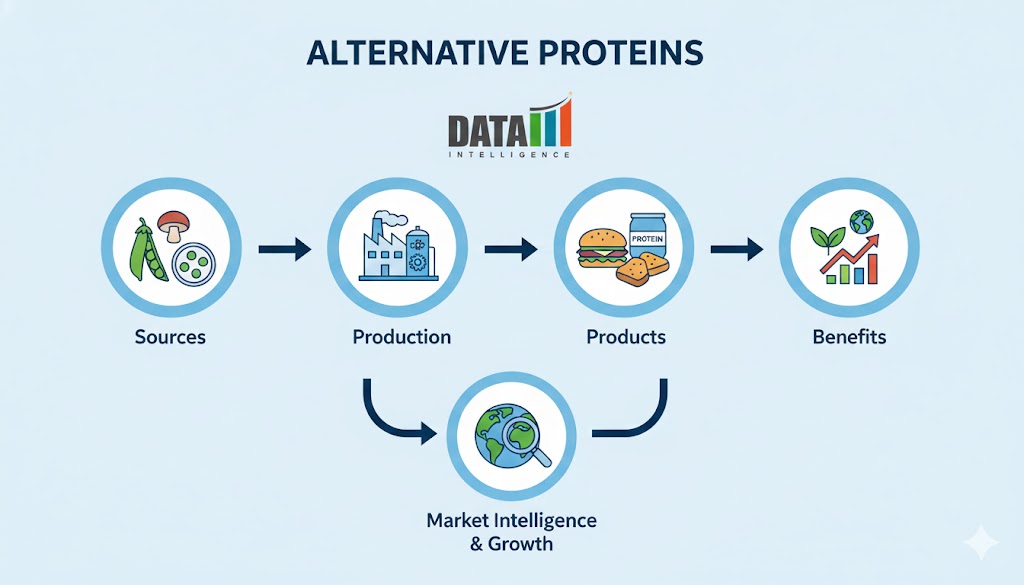
Global Alternative Proteins Market
Rising demand for sustainable nutrition and diversified protein sources is accelerating innovation across plant based, cultured, and novel protein platforms.
Alternative proteins are reshaping the global food system as sustainability, nutrition, and ethical sourcing drive consumers and industries toward innovative protein solutions. ”
LEANDER, TX, UNITED STATES, December 19, 2025 /EINPresswire.com/ -- According to DataM Intelligence, the global alternative proteins market was valued at US$34.3 billion in 2024 and is expected to reach USD 109.5 billion by 2032, growing at a strong CAGR of 15.6 per cent during the forecast period 2025 to 2032. Plant-based proteins represent the leading source segment due to wide consumer acceptance and scalable production. North America currently leads the market, driven by advanced food innovation ecosystems, strong venture funding, and early adoption of alternative protein products.— Sai Teja Thota | Research Head
𝗚𝗲𝘁 𝗮 𝗦𝗮𝗺𝗽𝗹𝗲 𝗣𝗗𝗙 𝗕𝗿𝗼𝗰𝗵𝘂𝗿𝗲 𝗼𝗳 𝘁𝗵𝗲 𝗥𝗲𝗽𝗼𝗿𝘁 (𝗨𝘀𝗲 𝗖𝗼𝗿𝗽𝗼𝗿𝗮𝘁𝗲 𝗘𝗺𝗮𝗶𝗹 𝗜𝗗 𝗳𝗼𝗿 𝗮 𝗤𝘂𝗶𝗰𝗸 𝗥𝗲𝘀𝗽𝗼𝗻𝘀𝗲): https://www.datamintelligence.com/download-sample/alternative-proteins-market
The global alternative proteins market is undergoing a significant transformation as consumers, food manufacturers, and policymakers shift focus toward sustainable and diversified protein sources. Alternative proteins include plant-based proteins, mycoprotein, insect protein, algal protein, and cultured meat developed to reduce dependence on conventional animal proteins. Rising concerns over climate change, food security, animal welfare, and health are accelerating the adoption of alternative protein solutions across food, feed, and pharmaceutical applications.
Recent Developments:
✅ In November 2025, Cargill announced investments in fermentation-based protein technologies to enhance sustainable protein production capabilities.
✅ In October 2025, Nestlé expanded its plant-based protein portfolio with new meat alternative formulations designed for improved taste and texture across global markets.
Key Highlights from the Report
➤ Strong growth driven by rising demand for sustainable and ethical protein sources
➤ Plant-based proteins dominate due to affordability and consumer familiarity
➤ Food and beverages remain the largest application segment globally
➤ Cultured meat and precision fermentation are emerging high-growth areas
➤ North America leads the market, while Asia Pacific shows the fastest growth potential
➤ Innovation in taste, texture, and nutrition is accelerating market acceptance
Market Segmentation
By type, the alternative proteins market includes organic and inorganic protein offerings. Organic alternative proteins are gaining preference as consumers increasingly seek clean-label, non-GMO, and sustainably sourced products. Inorganic protein alternatives are widely used in industrial applications where cost efficiency and scalability are prioritised.
By source, the market comprises plant protein, mycoprotein, insect protein, algal protein, cultured meat, and other emerging protein sources. Plant protein dominates the segment due to established supply chains and high consumer trust. Mycoprotein and algal protein are gaining momentum for their nutritional benefits and lower environmental footprint. Cultured meat represents a rapidly evolving segment focused on replicating animal protein with reduced resource use.
By form, the market is segmented into dry and liquid formats. Dry alternative proteins are widely used due to their longer shelf life and versatility in food formulations. Liquid proteins are gaining adoption in beverages, dairy alternatives, and ready-to-consume nutrition products.
By application, the market covers food and beverages, animal feed and pet food, personal care and cosmetics, pharmaceuticals, and other applications. Food and beverages account for the largest share as alternative proteins are increasingly used in meat substitutes, dairy alternatives, snacks, and functional foods. Animal feed and pet food applications are expanding as sustainable protein sources gain regulatory acceptance.
Looking For A Detailed Full Report? Get it here: https://www.datamintelligence.com/research-report/alternative-proteins-market
Regional Insights
North America holds the largest share of the global alternative proteins market driven by strong innovation ecosystems, high consumer awareness, and significant investments in food technology startups. The region benefits from advanced research facilities, regulatory support, and strong retail distribution networks.
Europe represents a major market supported by sustainability regulations, climate focused policies, and growing flexitarian populations. Asia Pacific is expected to witness the fastest growth due to rising population, increasing protein demand, urbanization, and expanding middle class consumption. Countries in the region are investing in alternative proteins to enhance food security and reduce environmental impact.
Market Dynamics
Market Drivers
The primary driver of the alternative proteins market is growing awareness of environmental sustainability and climate change. Conventional livestock farming contributes significantly to greenhouse gas emissions, land use, and water consumption. Alternative proteins offer a more resource-efficient solution while meeting global protein demand. Rising health consciousness and dietary shifts toward plant-based nutrition further support market growth.
Market Restraints
High production costs, taste perception challenges, and regulatory hurdles for novel proteins such as cultured meat remain key restraints. Consumer skepticism toward unfamiliar protein sources and limited scalability in early-stage technologies can slow adoption in certain regions.
Market Opportunities
Significant opportunities exist in product innovation, especially in improving taste, texture, and nutritional profiles. Emerging markets present growth potential as governments invest in sustainable food systems. Advancements in fermentation, cell-based agriculture, and protein processing technologies are expected to unlock new commercial applications.
Get Customization in the report as per your requirements: https://www.datamintelligence.com/customize/alternative-proteins-market
Reasons to Buy the Report
✔ Comprehensive market size and long-term growth forecast through 2032
✔ Detailed segmentation by type, source, form, and application
✔ In-depth regional analysis highlighting emerging opportunities
✔ Insights into market drivers, restraints, and future growth trends
✔ Competitive intelligence to support strategic decision making
Frequently Asked Questions (FAQs)
◆ How big is the global alternative proteins market?
◆ What is the projected growth rate of the alternative proteins market?
◆ Which source segment dominates the alternative proteins market?
◆ Which region is expected to lead the alternative proteins industry during the forecast period?
◆ Who are the key players in the global alternative proteins market?
Company Insights
Key companies operating in the market include:
• Beyond Meat
• Impossible Foods
• Archer Daniels Midland Company
• Cargill Incorporated
• Ingredion Incorporated
• Kerry Group
• Roquette Frères
• Tate and Lyle
• Tyson Foods
• Nestlé
Conclusion
The global alternative proteins market is positioned for rapid expansion as sustainability, health, and innovation reshape global protein consumption patterns. Plant-based proteins continue to dominate, while emerging technologies such as cultured meat and fermentation-based proteins offer long term growth potential. With strong momentum across North America and accelerating adoption in the Asia Pacific, alternative proteins are set to play a central role in the future of global nutrition through 2032.
Sai Kiran
DataM Intelligence 4market Research LLP
+ +1 877-441-4866
sai.k@datamintelligence.com
Visit us on social media:
LinkedIn
YouTube
X
Legal Disclaimer:
EIN Presswire provides this news content "as is" without warranty of any kind. We do not accept any responsibility or liability for the accuracy, content, images, videos, licenses, completeness, legality, or reliability of the information contained in this article. If you have any complaints or copyright issues related to this article, kindly contact the author above.
